

Why Journalists Say Florida's 2026 Election Is Unlike Any Before
Florida's voters are proving harder to predict than its numbers suggest. At a CommunityWire panel, four South Florida journalists explained how voter registration, redistricting, a debate that never happened, and social media are rewriting the playbook.
By Mariah Mela | CommunityWire
Oct 8, 2026
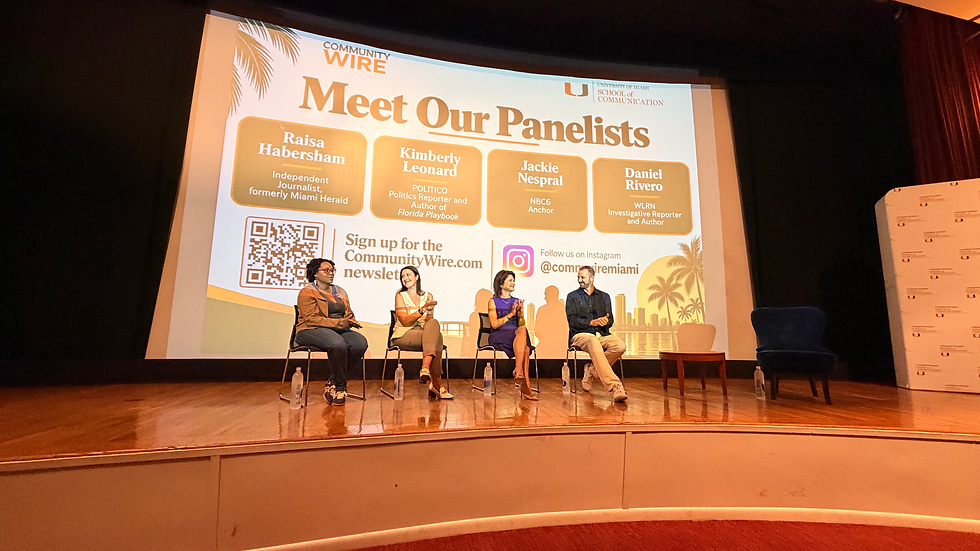
Raisa Habersham, Kimberly Leonard, Jackie Nespral and Daniel Rivero discuss election politics at a CommunityWire panel on the University of Miami campus on Oct. 6, 2026. (Photo By Mariah Mela).
By every past measure, Florida's 2026 midterm should already be decided. But with less than four weeks to go until Election Day, journalists covering it say it’s anything but clear who will emerge victorious in numerous competitive races.
That contradiction was at the center of a CommunityWire panel Oct. 6 at the University of Miami's Cosford Cinema, where Kimberly Leonard of Politico, Jackie Nespral of NBC6, Daniel Rivero of WLRN and independent journalist Raisa Habersham discussed what’s driving Florida voters and how this election looks quite different from any previous one.
On paper, the numbers favor Republicans more than ever. Florida now has more than 1.5 million more registered Republicans than Democrats, which is a sharp reversal from 2019, when Democrats led by more than 200,000. Newcomers to the state have tended to lean Republican, and voter roll maintenance has moved more Democrats than Republicans to inactive status, though inactive voters can still cast a ballot if they show up on Election Day with the proper ID.
But the panelists said those numbers no longer tell the full story.
“There are multiple factors that make this a very different cycle,” said Leonard, a reporter who writes the Florida Playbook for POLITICO. “It just adds to all the frustrations people have about high costs, gas prices…grocery prices, all these other things.”
Those frustrations are showing up in the polls. President Donald Trump's approval rating sits at 32% in the latest Reuters/Ipsos poll, the lowest of his presidency.
Leonard has heard that concern firsthand. In 2022 and 2024, she said, it was Democrats calling her, insisting Florida was in play. This cycle, Republicans are the ones calling her “panicking,” convinced “something's wrong.”
Health care has added to the pressure. This year, 440,000 more Floridians are uninsured than last year, after Republicans decided not to extend subsidies for Obamacare plans, she noted.
That uncertainty runs through the governor's race between Republican Byron Donalds and Democrat David Jolly. Jackie Nespral, who hosts NBC6's Sunday show “Impact,” said South Florida will be critical.
“It's just going to come down to who goes out and votes, because the polls say one thing, but it's who goes out to really vote in this election,” she said.
In South Florida, immigration is weighing heavily on that decision. Leonard said canvassers in Republican neighborhoods in Miami-Dade have been turned away at doors because a family member was deported or a worker with Temporary Protected Status (TPS) can no longer work.
The Miami-area journalists also took note of how immigration issues are playing out in a close congressional race between incumbent Republican Maria Elvira Salazar and Democratic challenger Elliot Rodriguez, both Cuban Americans. Salazar has been aligned with Trump but released an ad last month criticizing his immigration tactics.
Daniel Rivero, an investigative reporter for WLRN, saw that shift at a yard sale in the that race in the 27th Congressional District, where a Cuban American family had a lawn sign out front for Byron Donalds, who has been closely aligned with Trump. The woman told him ICE had been there that morning and showed him a video of agents taking someone in front of her house.
“This is someone with a Byron Donalds sign in front of their house, who's shaking her head, saying, ‘This is crazy,’ because she's seeing it with her own eyes,” Rivero said.
The immigration agenda driven by Trump and avidly pursued by term-limited Gov. Ron DeSantis isn’t the only factor shaping who is likely to turn out on or before Election Day. New congressional maps follow mid-decade redistricting, Rivero said, have left some Black voters determined to show up.
Democratic Senate candidate Angie Nixon, for one, is reaching them through new channels, he said, “flooding the zone on every talk show, every radio show, every online influencer campaign."
Those channels are increasingly replacing the classic old debate stage. For the first time in recent memory, Florida is not having a gubernatorial debate. Nespral said both campaigns had agreed to an NBC6 debate before Jolly withdrew, citing a toxic political climate.
“We had bought the equipment. We had done everything,” Nespral said.
Leonard said the hesitation crosses party lines, noting that Republican U.S. Senate Ashley Moody, Nixon's opponent, also won't debate – or give interviews to journalists. She pointed to the 2024 presidential debate that upended President Joe Biden's campaign as an example of how much one performance can matter.
“The fear is those clips going viral, and it's just driving this almost secrecy of ‘we're not going to talk about it,’” Leonard said.
Nespral agreed. “They're scared that they're going to make a mistake. They're going to say something, and it can and will be used against them. And with social media, it's going to be all over the place,” she said.
Journalist Raisa Habersham noted that debates reach voters who can't attend campaign events. “Some voters probably cannot and are unable to attend your town hall because they work,” she said.
Without a debate stage, more voters are hearing from candidates through influencers and podcasters. Nespral pointed to Joe Rogan's reach in the 2024 election, calling influencers and podcasters “a game changer in politics.”
That is what sets this election apart, as voters are hearing from candidates more than ever, but rarely seeing them questioned face to face.
And the voters doing the deciding are divided right down the middle, with 48% of Floridians approving of Trump's job performance and 48% disapproving.
On paper, Florida looks as red as ever. But on Nov. 3, voters could yet return Florida to the status it had a few years ago: a state that’s purple and not so predictable.
