Storytelling through Stone: Zimbabwean Art Comes Alive in South Florida
The ZimSculpt exhibition in the gardens of Bonnet House Museum & Gardens in Fort Lauderdale is a journey through African art and culture. It is open for visitors through April 19.
By Leelou Lambolez | CommunityWire
Apr 16, 2026

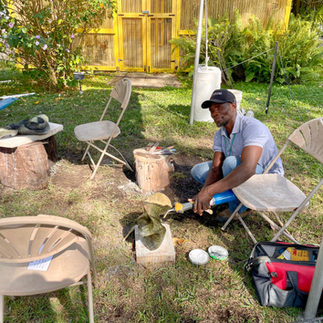
Passmore Mupindiko, a sculptor from Zimbabwe, is presenting his work at the Bonnet House Museum & Gardens through April 19. (Leelou Lambolez/CW)
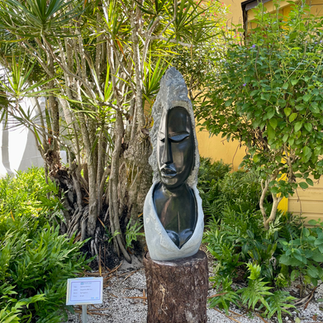
FORT LAUDERDALE, Fla. — Long before reaching the entrance of Bonnet House Museum & Gardens, visitors can hear the rhythmic sound of hammers hitting stone. Once inside, they find artists from Zimbabwe chiseling into hunks of natural rock, turning them into works of art. In these gardens, African music mingles with more than 100 artworks rising among the palm trees and orchids.
Each piece within the ZimSculpt exhibition is a journey across oceans, transforming a quiet morning in Fort Lauderdale into a dialogue between land, art and history. For many of the artists, stone carving is not just a profession, it is a tradition passed down through generations.
Passmore Mupindiko, one of the sculptors present at the exhibition, said he began carving when he was only 7, learning from his grandfather, who was a woodcarver. Born in Guruve, a village in Zimbabwe, he began his art journey to support his family after the loss of his father.
“Now I’m 50,” he said, “and I still love it.” His work is inspired mostly by nature, using the natural shape of the stone to guide the final form. “The shape I get on the stone, that’s what I use,” he explained while showing his current work.
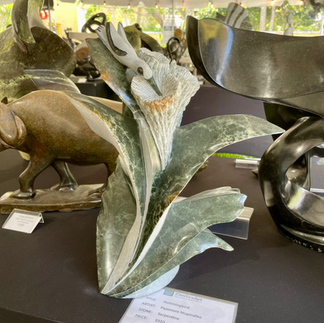
Around the gardens, sculptures represent animals, human figures or abstract shapes. Mupindiko explained how he was inspired to carve humming birds after seeing them in North Carolina during another exhibition.
“It took me about a week and a half to do this one,” he said as he was picking up his sculpture of a humming bird. “For the color, you just work on hand and sand paper to see the color. The more you work on it the more colors you have.”
Stone carving is deeply embedded in Zimbabwe's identity. It dates back to 1250 AD, when the ancient city of Great Zimbabwe, once the capital, was decorated with soapstone bird carvings. Though the tradition faded with the fall of that civilization, it was revived in the late 1950s through the Shona sculpture movement, which went on to gain worldwide recognition. Today, the Zimbabwe Bird - a soapstone sculpture found at the medieval city of Great Zimbabwe - remains the country's national emblem, proudly displayed on its flag.
ZimSculpt is curated by Vivienne Prince-Croisette, the organization’s founder, who has spent more than two decades bringing Zimbabwean sculptures to international audiences.
“I founded ZimSculpt 26 years ago,” she told CommunityWire. What began as small exhibitions in the United Kingdom eventually expanded across Canada and the United States.
Today, ZimSculpt works with around 300 artists from five different regions of Zimbabwe. Originally from England, Prince-Croisette and her French husband Joseph and their two kids travel to Africa regularly to collect the works directly from the artists.
“We buy everything outright from the artist,” she said. “So all the funds get redirected back to Zimbabwe.” The economic impact goes beyond the artists themselves. “It’s not just supporting them,” she added. “It’s their families, and then it trickles down into the community as well.”
According to James (Jim) LaBate, Chair member of Bonnet House for three years now, funding is a two way system. "We raised, I don't know, $50,000 and counting to support ZimSculpt,” he said in a phone interview.
"We get a small stipend to help offset our costs, but it's relatively minor,” LaBate said. “We've got to prepare the grounds, have sites and places for them to put everything, including their shipping containers.”
Transporting the sculptures is a journey in itself. Packed in Zimbabwe, they travel by container across the Atlantic to the United States, a trip that takes about two months.
“This year, shipping one 40-foot container from Zimbabwe to the United States cost $15,000, visas for the ZimSculpt crew amounted to another $15,000, and internal logistics across the United States reached approximately $25,000,” explained Joseph Croisette.
Prince-Croisette describes the exhibition as almost nomadic. “We’re a bit like a performing exhibit,” she said. The containers travel from venue to venue, allowing the sculptures to move across borders just as the stories they carry do.
Shine Muzika, the other artist onsite at Bonnet House, pursued his passion despite limited schooling and has now captivated audiences worldwide. The two artists work onsite throughout the exhibition using only hand tools, hammers, chisels, sandpaper and rasps – course files that feature raised, durable teeth. The two artists demonstrate how the stone is shaped, slowly and patiently.
The experience is not only visual but emotional. Katia Cardon, a French hairdresser who discovered the exhibition through a meeting with the organizers, said she was struck by what the sculptures express.
“I find it extraordinary, all this emotion that you can feel with stone,” she said. “Bringing a different culture to the United States is essential especially in these difficult times, globally, economically, politically,” she explained. “We need the outside world to understand other communities and I think it can be done easily through this because it's an emotion and we can all share these emotions.”
She was especially moved by a sculpture of a giraffe. “It represents family, union, and serenity,” she said. For her, the animal also symbolized balance in nature. “It’s part of the cycle of life without interrupting other lives.”
Bonnet House, the historic estate built over a century ago, has become the meeting place between continents, where Zimbabwean stone art interacts with Florida’s tropical environment. The exhibition also challenges common ideas about African art by showing contemporary creativity rooted in tradition. For Prince-Croisette, the goal is not only to exhibit art but to create exchange. “If people have great ideas, you just have to start small and build up,” she said, reflecting on how ZimSculpt began.
When sculptures are sold, new works replace them. Each piece that leaves the garden makes room for another story to arrive. In that way, the exhibition is never fixed; it changes as people interact with it.
To explore the exhibition, visitors can pay $15 to visit the grounds, or $30 to experience the historic house as well. Admission for children ages 6-17 is $8.
Mupindiko and Muzika invite the public to encounter their stone sculptures throughout the exhibition at Bonnet House Museum & Gardens until April 19.
All photos and video by Leelou Lambolez for CommunityWire at the University of Miami. News organizations are welcome to republish our material, provided they credit the writer and CommunityWire.