

Coral in Crisis: In a world largely designed by men, Ximena Caminos uses art to build a livable future and healthier oceans
Off the coast of Miami Beach, an underwater sculpture park serves both as a carbon-capturing reef and an example of women's leadership. It's founder wants people to have a "marine epiphany." This story is the second in a series highlighting bold initiatives to save Florida's coral reefs.
By Leelou Lambolez | CommunityWire
Jul 27, 2026
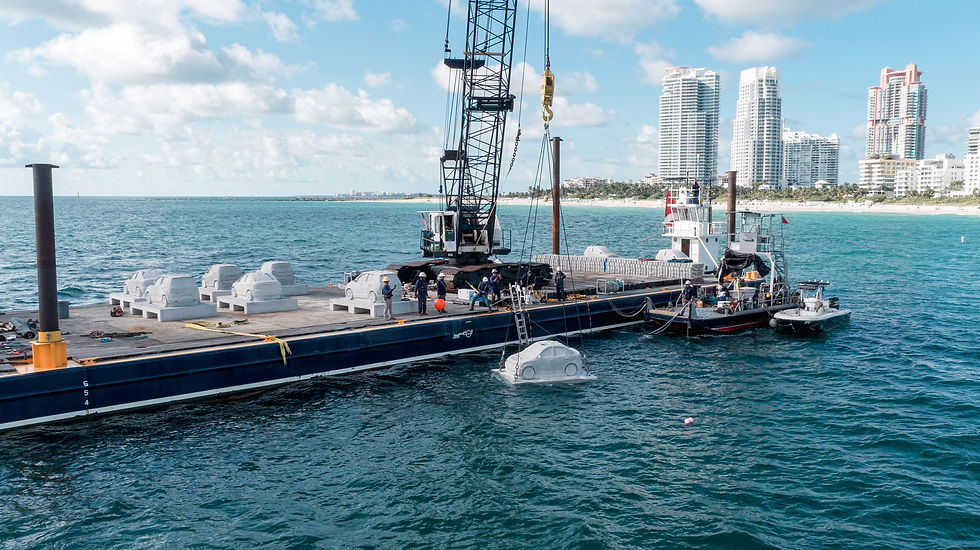
Deployment of the underwater sculpture on the Reefline (Photo: Steve Kehayias)
Twenty feet below the surface off Miami Beach, something remarkable is taking shape. A seven-mile underwater ecosystem designed to capture carbon rises from the sand: The ReefLine. Alive, evolving, and unlike anything else in the world, it exists because of one woman’s vision: Ximena Caminos.
Caminos, an Argentine environmental activist, artist and cultural placemaker, works with artists and cross-disciplinary teams to redefine the offshore of Miami Beach.
More than a sculpture park, The ReefLine is a living lesson to the world, demonstrating that cities can choose imagination over destruction, that women can lead large-scale environmental projects and that culture can rewrite our relationship to the water that surrounds us.
It was not by choice that Caminos moved her bags to the Sunshine State 12 years ago. “I didn’t choose Miami… I had to come,” she said. “I was commissioned to do a project here called a large-scale cultural district: the Faena District.”
Growing up in Buenos Aires, her background shaped her relationship to nature and creativity. She now holds dual citizenship, a reflection of both her roots and her long-term commitment to her work in Miami.
“I think that being outdoors all the time, horseback riding, gardening, it did help me shape my passion for nature,” she said. “I was an activist before I was an artist.”
From South America to the United States, Caminos built her reputation in art and environmental conservation. She has worked on the Faena District project, served as a member of the Solomon R. Guggenheim Museum's Latin American Circle and founded the ocean-centric nonprofit BlueLab Preservation Society. Yet it is the ReefLine that has become her life’s work.
She hopes her project inspires a deeper connection between people and the ocean. “I hope they have an epiphany, like a marine epiphany,” she said. “And they fall in love with the water and they learn to protect it, just like we do.”
Caminos’ story highlights how women leaders can connect science, culture and community, using creativity to inspire action and long-term environmental care.

From one conversation to seven miles of coral
The ReefLine began as a simple conversation with marine biologist Colin Foord, co-founder of Coral Morphologic. “It was born out of a conversation with Colin,” Caminos said.
Miami’s environmental urgency was impossible to ignore: bleaching reefs and rising seas. Caminos imagined what she called an “underwater cultural infrastructure,” a space where art and marine science could coexist and heal.
“It takes a village… it is really a collaboration,” she insisted. “I choreograph the collaboration, I am kind of like the master orchestra director. Let’s say the chef, but there’s a lot of sous-chefs in the kitchen as well.”
Foord, 43, spoke from the deck of the boat where he had been working all day, positioned directly above the ReefLine structure.
“We sat down and talked about what could come next,” Foord said. “I told her she would be the ideal person to lead an underwater sculpture park off Miami Beach.”
The results of this collaboration are groundbreaking: structures built from Carbon Xinc, a cement-free material that can capture carbon while supporting marine life.
For Foord, the scientific work behind the project is just as important. “I have been focused on growing the soft corals that we will be out planting onto the cars, probably in January, early 2026,” he said.
He and his team rescue over gorgonians torn from nearby reefs and prepare over 2,200 of coral fragments to anchor onto the structures. This slow and meticulous work ensures that the ReefLine functions not just as artwork, but a functioning ecosystem.
For Foord, Caminos brought what the project needed to succeed.
“She had the political influence, the social influence, and the artistic vision. She was the only one who could make that happen,” he said as his voice carried the background sounds of wind and waves. “There is something poetic about nature taking over human structures.”

Making the ocean personal
Caminos believes that art has the power to create an emotional connection between people and the ocean, making environmental preservation personal and necessary. She believes that artists, not just policymakers, have a role to play in finding solutions to climate change.
“A sustainable city means that we live in a way where we’re not extracting more than what we’re taking,” she said. “The problem is that we don’t have enough time. Evolution is slower than our destruction. That’s the thing.”
Foord noted that one of the project’s greatest impacts is shifting how Miami residents see their own coastline. “A lot of people didn’t even realize we had a coral reef ecosystem so close to shore,” he said. “Now they’re seeing their city in a totally different way.”
Caminos shows how imagination, art, and environmental responsibility can coexist in urban spaces, demonstrating a model of leadership that inspires collective action.
Hacking a man’s world with art
Architecture, urban planning, environmental engineering, and cultural policy remain largely male-dominated fields. Caminos has navigated these worlds with creativity, persistence, and art as her tool.
“I think as women, we’ve learned to be able to somehow hack that world,” she said. “The way I had to hack that system was actually through the arts. The arts opened that world for me and let me lead.”
Brandi Reddick, a Georgia native, and now the executive director of the ReefLine, emphasized how women are reshaping the field.
“When I started working in public art 20 years ago, it was a male-dominated field… I would walk into meetings where I was the only woman in the room,” said Reddick, who has now lived in Miami for 25 years.
But her own experience shows how dramatically the landscape has changed for women.
“We're a woman-led organization, and primarily the root of our organization is all women, so we're pioneering through public art and also in ocean conservation,” she said.
“In coral restoration, the new generation is more female,” said Foord. “Caminos is certainly a visionary when it comes to really large scale projects. There's a lot going on besides just the art and curation. You have to convince the city.”
Caminos points to Miami’s history of female leadership as part of her inspiration. “Miami is a city that has a history of visionary women pushing the envelope,” she said.
Her work offers a model for other women in environmental and cultural fields, demonstrating how creativity and courage can carve space in male-dominated industries.
Even over the phone, Reddick’s warmth was unmistakable. She laughs easily, her smile audible in the lift of her voice as she reflected on Caminos and the years of collaboration between them.
“We are like the yin and yang to each other,” said Reddick. “Ximena has grand, wonderful visions, and is really passionate about using art as a tool for change.”
According to Foord, Caminos is absolutely a role model in this space. “She’s created a kind of family. It’s relaxed, creative, collaborative.”
Caminos’ career illustrates a leadership style that values mentorship, inclusivity, and long-term thinking, qualities increasingly recognized as essential in shaping sustainable cities and ecosystems.
The ReefLine invites Miami residents to reconnect with the ocean, participate in its preservation, and learn through art.
“Citizens of Miami Beach voted to tax themselves to make our project happen,” Caminos said. “It’s inspiring a lot of students and schools.”
Reddick explained that this year the project reached classrooms across the county.
“We introduced the ReefLine to 100 Miami-Dade County public schools, reaching over 10,000 students,” she said.
As a marine biologist, coral aquaculturist, artist, and filmmaker, Foord explained accessibility is central to the project’s impact.
“I think it, from a community perspective, the fact that we can create something that’s freely accessible from shore is a really important contribution to the city and the county and how people are able to see Miami with a different perspective rather than just a party vacation place.”
“We’re only in phase one and we still have 11 more phases to go,” Caminos said. With this approach, Caminos demonstrates that large-scale projects can integrate art, science, and community engagement to produce lasting impact.
Eleven Phases, Ten years
Reddick outlined the project’s next steps and the long-term vision for ReefLine.
“We will be entering into phase two, which is coming up next year, and we will have a couple more deployments,” Reddick said.
“The ultimate goal of ReefLine is to expand the seven-mile coast of Miami Beach over the next 10 years. We think it's going to take us 10 years to complete it.”
She emphasized that the work happening now is laying the foundation for something much larger, a model that other coastal cities could one day adopt.
“We also want ReefLine to serve as a blueprint for coastal cities around the world,” she said. “There are [cities interested], and we're speaking with Monaco through the Prince Albert Foundation and other preliminary conversations.”
Despite the scale of her project, Caminos remains focused on its completion while reflecting on the lessons it teaches.
“Sometimes an idea might sound a little difficult or complex, but actually… if you try hard enough and don’t give up, you might be able to do it,” she said. “Nothing good comes easy. If you’re brave and determined, most everything can be achieved.”
This story is the second in a series of three by journalist Leelou Lambolez. News organizations are welcome to re-publish this story or the entire series of three, as long as they credit Leelou Lambolez and CommunityWire.Miami.