

Corals in Crisis: How a student-led project is helping protect Miami's coral reefs from extreme high temperatures
University of Miami graduate students are in a race to prevent coral bleaching before more irreversible damage is done. The Kanopi project, a hexagon-shaped floating shade, is buying coral reefs time – for now. This story is the first in a series highlighting bold initiatives to save Florida's coral reefs.
By Leelou Lambolez | CommunityWire
Jul 22, 2026
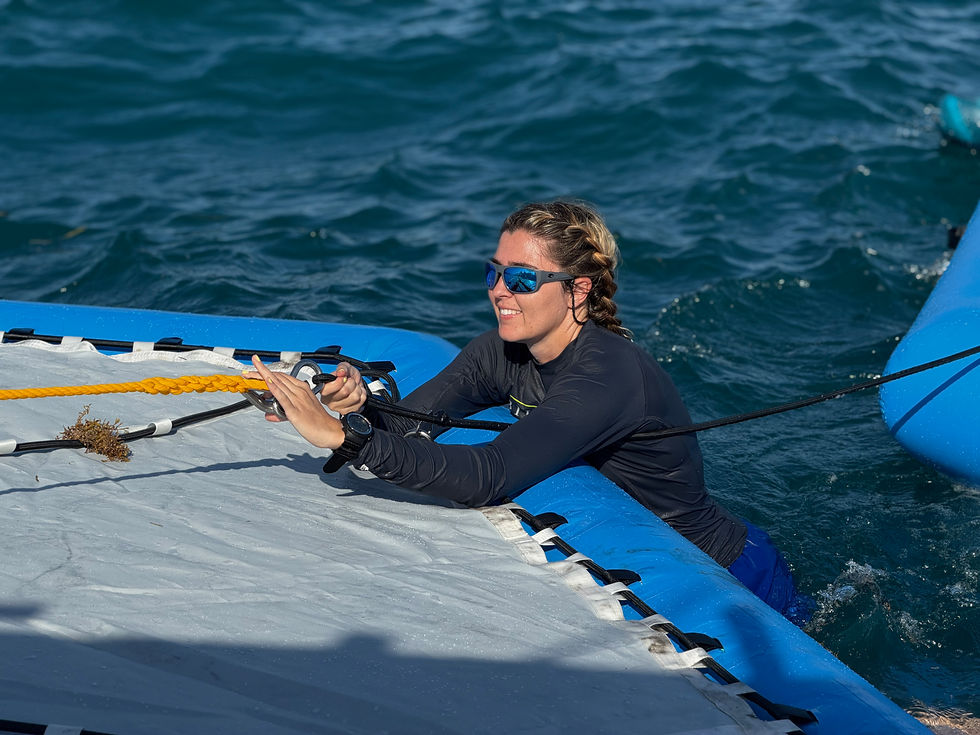
Danielle Bejar in the water during the deployment of the units (Photo: Joseph Unsworth)
It was a foggy morning in late January on the shore of Key Biscayne when Danielle Bejar and her team were already on the water, ready to launch the Kanopi units, a new solution to Florida coral reefs bleaching issue. As they moved away from shore, the sky cleared, revealing Miami’s skyline and Flamingo Reef below the surface ready to be shaded.
After almost two years of work, the world’s first modular, rapidly-deployable coral reef shading system was finally put to the test in the open ocean. “Inspired by research that has been conducted and improving upon methods that already exist, the team came up with Kanopi,” said Bejar, 26, doctoral candidate at the University of Miami in the civil engineering department.
But when a sensor, designed to measure water temperature and light penetration below the surface, started sinking toward the ocean floor, Bejar did not hesitate. She dove 15 feet on a single breath and grabbed it before it disappeared. “The rest of our team would have been like, no, we need some kind of mechanism to grab it from the surface,” said Kylee Rux, a teammate and close friend, laughing.
The deployment took place in a place special for Bejar. It was just a few miles away from where she grew up: Fort Lauderdale. Living five minutes away from the beach created a commitment and passion for the ocean. “She loves manatees, sea turtles, everything to do with the ocean,” said Duncan Van Kouteren, her husband. “She's been around it her whole life and wants to do everything that she can to help protect it.”
After completing a master's degree in ocean engineering, Bejar is now a doctoral candidate at the University of Miami. She embarked on the Kanopi project with three other students. They had a mission: cool down the coral and help prevent bleaching before irreversible damage is done. “We designed a floating coral reef shade to alleviate coral reefs from coral bleaching,” said Bejar, sitting at her desk beneath an ocean poster, wearing a floral dress.
As South Florida simmers through another heat-wave summer, it is becoming impossible to ignore the crisis happening beneath the surface of our oceans.
Coral reefs, often called the “rainforests of the sea,” cover less than 1% of the ocean floor but are home to nearly 25% of all marine life as well as being a natural powerful shoreline protection.
Yet high water temperatures, sea level rise, and pollution are pushing them to a breaking point.
Florida’s reefs, one of the world’s largest barrier reef systems, have already suffered multiple episodes of mass bleaching in recent years. This summer, as the heat intensifies, the stakes could not be higher.
In this special series, “Corals in Crisis,” CommunityWire takes you beyond the science and immerses you in the lives of the people fighting, dive after dive, lab after lab, grant after grant, to save coral reefs from extinction.
A race to stop coral bleaching
For those who work alongside her, Bejar is as much a leader as she is a scientist. “She is a very big galvanizer of the team,” said Joshua Prabahar, one of her teammates. “She's very positive-minded, very organized, she helps us get back on track when we sometimes deviate in our thoughts."
Rux agrees. “She has been awesome to work with. We're both passionate about ocean conservation, growing up in completely different parts of the U.S. We're not scared to disagree with each other, to come up with the best solution possible,” she said.
Last December, Bejar went scuba diving at Molasses Reef in the Florida Keys. “It's a reef my mom used to love because of the colors and all that,” Bejar said. “But when I went, it was dead,” she said, her smile fading. “It's like first the coral goes and then the fish go ... it's that domino effect.”
According to NOAA's Coral Reef Watch, the world is currently experiencing the largest coral bleaching event on record, affecting 84% of the world's reefs. Florida has lost 90% of its coral cover since the 1970s.
“What's become very apparent in the past few years, especially in Florida, is the global bleaching event that's going on. Corals are dying out and there isn't much being done to save them,” said Prabahar. The consequences reach far beyond the ocean floor. “Coral reefs provide so much coastal protection for Florida, food security, they contribute to the local economy through tourism. This is a prime location to be studying this,” said Rux.

The Kanopi project is a student-led initiative born at the University of Miami. “We just came together with Montel Tuen, Danielle Bejar and Kylee Rux to start this project,” explained Prabahar, a 24-year-old doctoral student in mechanical engineering. The solution they landed on was not their first idea.
“Originally we started with basically pumping cold water directly on the corals to cool them. But we quickly found out from a simulation that it's just impractical,” said Prabahar. From there, the team shifted their focus to shading.
“We're actually trying to work on something that's going to save the corals that we currently have, rather than trying to replant the corals that have died out,” he said.
The Kanopi project is a bio-inspired, hexagon-shaped floating shade. Its main purpose is to shield coral reefs from harmful UV rays that can cause bleaching. “During our first deployment we showed that the Kanopi produced about 65% shading at 10 foot depth,” said Bejar. The project gained momentum after receiving an award from the National Marine Sanctuary in a design competition for a coral stress challenge in the fall of 2024.
“Everyone that we've spoken to has given us positive feedback,” said Prabahar. “Everyone really understands the necessity to save the corals from dying out.”
After almost two years of work, the first deployment took place in late January. “I was a bit hesitant on how our first deployment would go,” said Rux, a third-year doctoral student in civil engineering. “But I thought it went a lot better than what I was anticipating.”
The team set out to deploy six Kanopi units. The morning was not without its challenges, on a boat with limited space and waves rocking beneath them, the team had to inflate each unit while half of it hung off the side of the vessel. “We proved what? That a shade produces shade. So that went well,” said Bejar with a little humor.
The main objective of the deployment was to observe the difference between pool testing and the open ocean, and to see how maneuverable the units would be. Data was collected over several hours while the units shaded the reef. The system measured light and temperature as well as the shading provided.
“We actually were able to see some noticeable difference in the water temperature underneath the Kanopi. It wasn't our goal to really reduce the temperature itself, but we actually were able to,” said Prabahar.
Refining the design, securing the funds
Despite the positive results, the team is still working to improve before the next mission. “When you're out on the water, you just have the bow of the boat, limited space," said Bejar. "We need to refine the design of the units to make them a little more sleek and easily maneuverable."
A second deployment has since taken place, this time with two coral reef restoration practitioners from Reef Renewal and Mote Marine Laboratory. “We want to design Kanopi so that it is convenient for them to use,” said Bejar. “They will be the end users of the product.”
None of this has come without a financial cost. Each Kanopi unit costs approximately $600 to manufacture. The team received $20,000 after winning the National Marine Sanctuary design competition, followed by an additional $10,000 from Oceanetics, a private marine industry company. More recently, they received funding through VentureWell's Pioneer Program, a startup accelerator for student-led enterprises. “Any additional money raised will go toward further testing expenses, including vessel rental, and manufacturing more units.” explained Bejar.
The team is currently applying for additional grants and funding competitions as costs continue to grow. “We wrote down all of the lessons learned, anything that went wrong, anything that went right, so the next step is to go through that,” said Bejar. “Simultaneously, we're applying to different funding sources”.
Another challenge extends beyond just designing the units: balancing the project with their doctoral programs. “We're all going to graduate eventually,” said Bejar. Her husband sees the weight of it all from home. “She's put in a lot, a lot of work, a lot of hours into this,” he said. “She's a mix of stressed and hopeful.”
The team is already thinking about the future of the project and making clear they are open to new members. “I'm excited to see what kind of people we can bring, who want to take this to the next level, whether that's future doctoral students or volunteers,” explained Bejar.
Despite their efforts and commitment, most of them know the shade is not a sustainable solution in the long term.
“Kanopi, we hope, isn't a permanent solution,” said Prabahar. “It's really buying us more time in the global scheme, corals are dying out and we need to save the ones that we have. While other engineering solutions are being developed, we need to do something to help the corals right now.”
For Bejar, the urgency is personal. She has seen the gray rocks where colors used to be. She has felt what it means to lose something you grew up loving. And she is still in the water.
“We are a mitigation strategy for coral reef bleaching,” said Bejar. “Because if it's just rocks, then there's nothing for us to do.”
This story is the first in a series of three by journalist Leelou Lambolez. News organizations are welcome to re-publish this story or the entire series of three, as long as they credit Leelou Lambolez and CommunityWire.Miami.