

Between Two Governments: How Venezuelan Voices May Impact Election Day
After being let down by both Venezuelan and U.S. governments, Venezuelan and other Latino voters in Miami are hoping that the midterm elections will bring in leaders that keep their promises.
By Charlie Rincon | CommunityWire
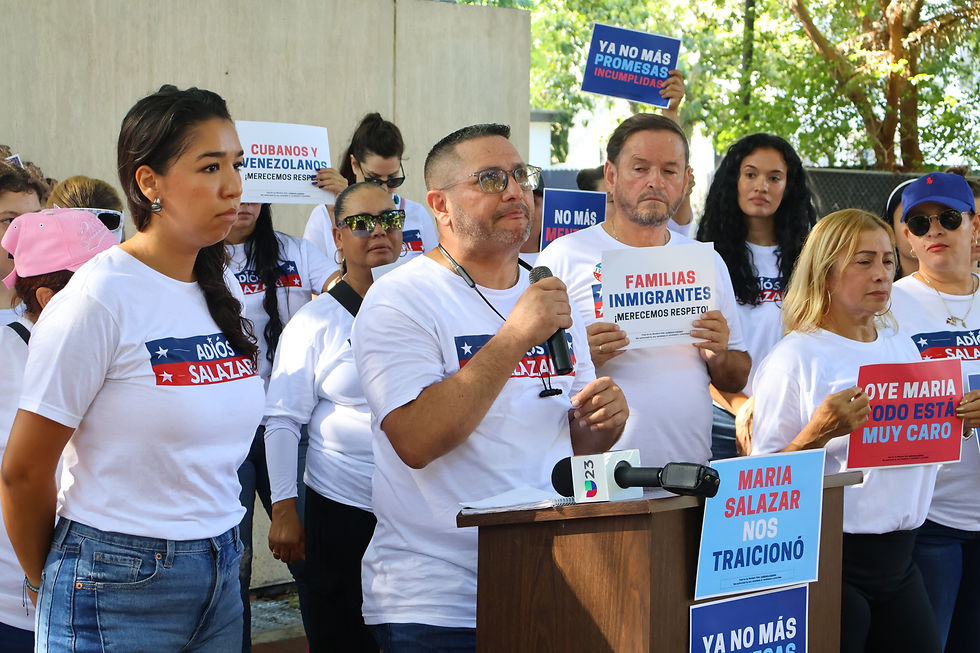
A crowd of Venezuelan and other Latino immigrants speaking at an event in Miami's Little Havana on Oct. 29. (Photo courtesy of UNITE HERE Local 355)
A housekeeper during the week and an Uber driver on weekends, Juan Herrera, 52, is one of many Venezuelans who left everything back home to find a new life.
“At one point when I lived in Venezuela I lived a very comfortable life, I worked as a banker and had a nice apartment. I even had my own housekeeper, but the quality of life was declining. The economy was declining. I left the country during the Chavez regime because there is no life when you're living under a dictatorship,” he said. “Getting robbed at gunpoint on a regular basis shouldn't be the norm.”
For many Venezuelans living in the U.S., there's a profound feeling of betrayal ahead of Election Day. It's a disappointment not only in the government they fled, but also from international leaders they once believed would help during a time of need.
After President Donald Trump staged a military intervention to remove Nicolas Maduro from power in January, many believed it would mark the beginning of a new democratic era in Venezuela. The central leader of the opposition movement, Maria Corina Machado – who was cultivating a relationship with Trump, and even gifted him her own Nobel peace prize – was expected to be the next leader following Maduro’s removal.
Instead, what endured was a growing alliance between the Trump administration and Delcy Rodriguez, Maduro’s former vice president, prioritizing oil negotiations, leaving many to question whether the government's interest truly lies in restoring democracy or their own political and economic interests.
“I feel betrayed. Yes, they removed Maduro, but they left Delcy in charge, which is essentially the same thing. When we needed more help after the earthquake in June, the Venezuelan government responded just as Maduro would have. I thought the U.S. government was going to step in and help, but it didn’t,” said Maria Rodriguez, a Venezuelan who has been a U.S. citizen for over two years.
Over the last few months there has been a growing frustration among Latinos living in the U.S. towards Rep. Maria Elvira Salazar, particularly over her stance on immigration. While she once promised to help immigrants and supported policies to protect undocumented people, some might argue that her support for Trump’s immigration policies has left many facing deportation, losing protections or stuck in a legal limbo.
Salazar has sought to distance herself from Trump's anti-immigration stance, which has included ending TPS for Venezuelans and 12 other nationalities, by releasing a controverial ad critizing the president. She is being challenged for her seat by Eliott Rodriguez, who is also a former local TV journalist; Both are of Cuban descent. The two are in a statistical deadheat ahead of Election Day.
On Oct. 29, Latino workers met at the José Martí Memorial in Little Havana to express their discontent over Salazar’s broken promises.
“I have been living in District 27 for the past 17 years, and I was once registered as a Republican. Today, I feel betrayed and disappointed by Maria Elvira Salazar,” said Martha Cabrera, a voter who changed her registration to Non Party Affiliated (NPA) this year. “She promised to help our immigrant community, but it’s all been lies. She supported giving $75 billion dollars to ICE to deport us and to commit crimes against us. She supported unjustly cutting the benefits of the elderly. I feel very disappointed, just like so many others who once gave her our vote.”
Voters and residents of Salazar's district raised concerns about the cost of living in Miami and how it has become one of the least affordable cities in the nation for working families.
“I come from a country where there is a lot of mistreatment, where there are many injustices,” said Maikol Rodriguez, a Venezuelan worker and member of UNITE HERE Local 355, a union that represents workers in the hospitality industry.
“I left for that reason, because of the dictatorship. I fled because I believe in defending what is just. I had a chance to fight for justice in my country, and I’m here to continue that fight here,” said Rodriguez. “Because every immigrant who comes here to this beautiful country comes to fight for a better life. Latinos help make this country, and we deserve respect. It’s not fair that in a free country, there are so many people living in fear."
Research shows that Latinos constitute nearly 70% of the population in Miami-Dade County, making the Venezuelan vote here particularly important. With immigration policies directly affecting their families and loved ones, voters are paying much closer attention to politicians keeping their word.
“No politician can serve two masters forever. Salazar attempts to present herself as a compassionate advocate for immigrant communities, yet her legislative record tells a different story,” said Ana Sofia Pelaez, the Executive Director of Miami Freedom Project. “No amount of performative lip service can erase her votes in Congress, which enabled the very immigration policies she only disavowed when her election was on the line.”
This time around there is a combination of fear, frustration, and anger that is driving the Latino population to take action. For those like Herrera, who left Venezuela in the early 2010s in search of a better life, these elections feel personal. They are no longer watching political decisions happen, they are becoming part of the process and demanding for those in power to take accountability and keep their promises.
